
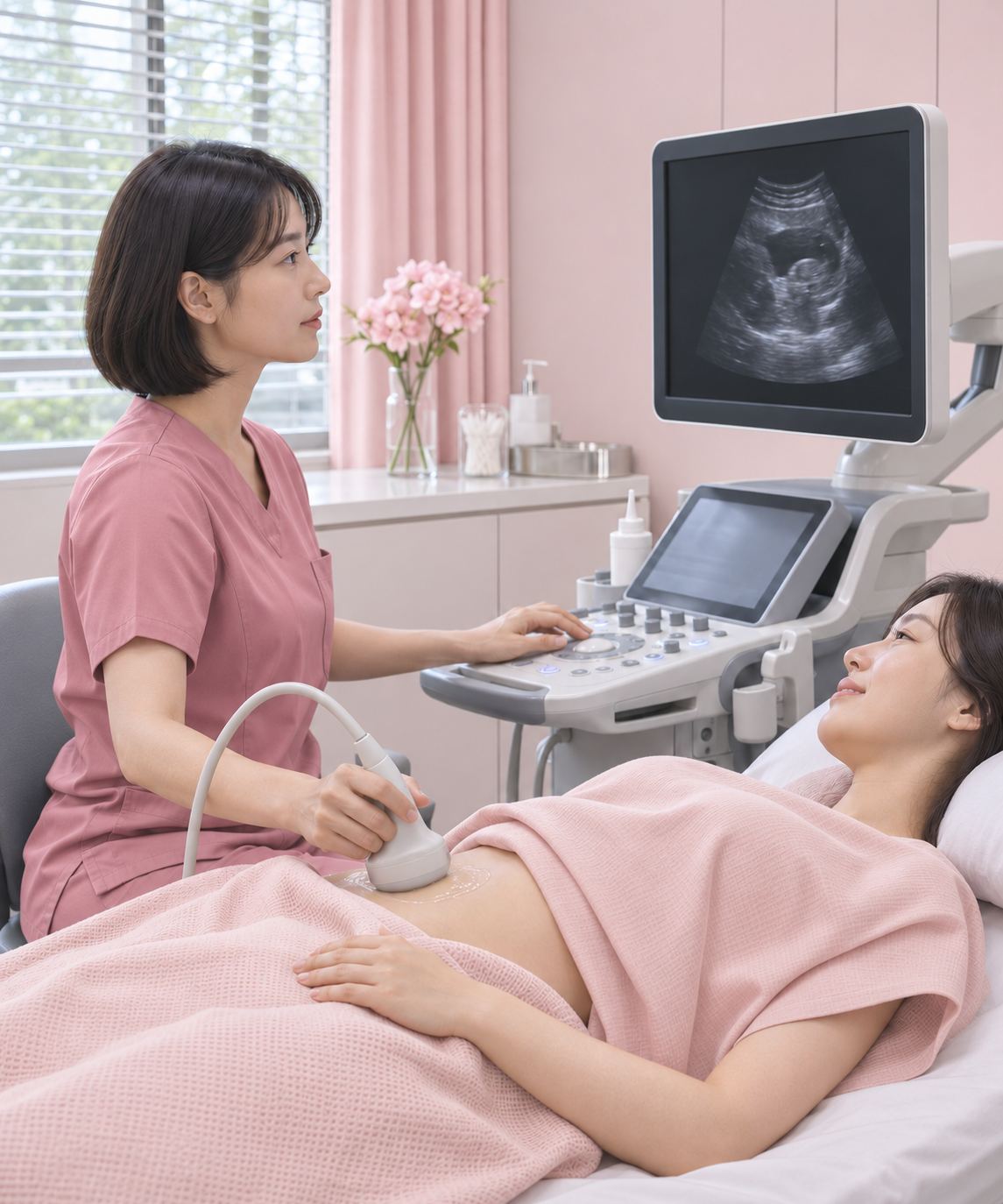
A breast ultrasound uses sound waves to look at breast tissue and is often used to check a lump, localized breast pain or dense tissue seen on a mammogram. Foreigners in Seoul can book one at Yoonho Women's Hospital in Apgujeong without a referral. The scan usually takes about 15–30 minutes, involves no radiation, and results are explained in English.
- Scan time
- About 15–30 minutes
- Radiation
- None
- Preparation
- None; a two-piece outfit helps
- Best timing
- About 7–10 days after your period starts
- Referral
- Not required
- Results
- Explained in English; report on request
What does a breast ultrasound show?
A handheld probe sends sound waves into the breast and turns the echoes into real-time images. Ultrasound is particularly good at telling whether a lump is fluid-filled(such as a simple cyst) or solid(such as a fibroadenoma, which then needs a closer look).
- Checking a lump or thickening you or a doctor can feel
- Looking more closely at an area seen on a mammogram
- Examining dense breast tissue, where mammograms can be harder to read
- Checking lymph nodes in the armpit
- Guiding a needle biopsy when one is needed
Ultrasound does not replace mammography for screening: it can miss tiny calcium deposits (microcalcifications) that mammograms detect.
Breast ultrasound vs. mammography
| Breast ultrasound | Mammography | |
|---|---|---|
| How it works | Sound waves, handheld probe | Low-dose X-rays with breast compression |
| Radiation | None | Low dose |
| Strengths | Cysts vs. solid lumps; dense tissue; younger women | Microcalcifications; population screening |
| Limits | Can miss calcifications; depends on operator | Less sensitive in dense breasts |
| Typical use | Symptoms, follow-up, supplement to mammography | Routine screening, usually from age 40 |
In Korea's national cancer screening program, women aged 40 and older who are enrolled in National Health Insurance are offered mammography every 2 years. Your doctor may suggest adding ultrasound if your breasts are dense or you have symptoms.
Who should consider a breast ultrasound?
- Anyone with a new breast lump or thickening
- Breast pain in one specific spot that does not follow your cycle
- Nipple discharge, especially from one side
- Dense breast tissue reported on a previous mammogram
- Follow-up of a known cyst or fibroadenoma
- Women under about 30, or pregnant or breastfeeding, with a breast symptom — ultrasound is usually the first test
- A lump or thickening you can feel
- Breast pain in one area
- Dense tissue noted on a mammogram
- Uncertainty about whether to worry
- Fluid-filled vs. solid areas distinguished
- A BI-RADS category and clear next step
- An English report for your home doctor
- A follow-up plan if anything needs watching
Booking and your visit, step by step
- Book or walk in Message us on WhatsApp or KakaoTalk, or walk in during clinic hours. No referral is needed.
- Bring your records Passport or ARC, any previous mammogram or ultrasound reports (images on CD or USB if you have them) and a list of medications.
- Consultation in English Your symptoms, family history and cycle are reviewed, and the breasts are examined.
- The scan You lie on your back with your arm raised. Warm gel is applied and the probe is moved over each breast and the armpit.
- Results The doctor explains the findings and the BI-RADS category in plain English.
- Next steps Routine follow-up, a repeat scan in a few months, or referral for mammography or a biopsy if needed.
How are results reported? (BI-RADS)
Breast imaging results are usually given a BI-RADS category, an international system that links findings to a recommended next step.
| Category | Meaning | Usual next step |
|---|---|---|
| 0 | Incomplete | More imaging needed |
| 1 | Negative | Routine screening |
| 2 | Benign finding (e.g., simple cyst) | Routine screening |
| 3 | Probably benign | Short-interval follow-up, often about 6 months |
| 4 | Suspicious | Biopsy recommended |
| 5 | Highly suggestive of cancer | Biopsy and specialist care |
Most findings fall into categories 1–3. If a biopsy is needed, the doctor will explain where it can be done and provide an English summary for the next doctor.
Cost, insurance and English documents
The cost depends on whether the scan is for symptoms or screening and on any additional tests; you will receive an estimate at your visit. For residents enrolled in National Health Insurance, ultrasound for symptoms or a suspected problem may be partly covered, while screening-only scans are usually self-pay. See health insurance for foreigners at Korean clinics.
Visitors can request an itemized receipt and an English report or certificate for travel insurance claims. A breast ultrasound can also be combined with a women's health checkup.
Why international patients choose Yoonho
Frequently asked questions
Does a breast ultrasound hurt?
Most people feel only gentle pressure from the probe and the coolness of the gel. If an area is tender, tell the doctor and they will adjust the pressure.
Do I also need a mammogram?
It depends on your age, symptoms and history. From about age 40, mammography is the standard screening test, and ultrasound is often added for dense breasts or a specific concern.
Can I have a breast ultrasound while pregnant or breastfeeding?
Yes. Ultrasound uses no radiation and is the usual first test for breast symptoms during pregnancy and breastfeeding.
Can foreigners use Korea's free breast cancer screening?
The national program is for people enrolled in National Health Insurance, generally offering mammography every 2 years from age 40. Short-term visitors pay for imaging themselves.
Can I take my results home?
Yes. You can request an English report, and ask whether images can be provided so your doctor at home can compare future scans.
What happens if something suspicious is found?
The doctor will explain the finding and arrange or refer you for further imaging or a biopsy, with an English summary to take with you.
OB-GYN Specialist · Director of OB-GYN
M.D., Ewha Womans University College of Medicine · Former Clinical Instructor, Ewha Womans University Mokdong Hospital · Member, Korean Society of Menopause
Last reviewed: . This page is for general information and does not replace an in-person consultation.
Talk to an English-speaking gynecologist
Yoonho Hospital · 304 Apgujeong-ro, Gangnam-gu, Seoul · Mon–Fri 9:00–18:00, Sat 9:00–13:00 · Walk-ins welcome.